
From arete to virtue
Arete (ἀρετή) is excellence of any kind, virtue instantiated with one's every action.

“... in showing the way to virtue, we must be thankful. Such an one I take myself to be, excelling all other men in the gift of assisting people to become good and true...”
Plato, Protagoras
ᾰ̓ρετή • (ăretḗ)
goodness, excellence
manliness, prowess, rank, valor
virtue
character, reputation, glory, fame, dignity, distinction
miracle, wonder
Virtue (from the Latin virtutem; virtus) - (vir meaning “man” (from PIE root *wi-ro-) is excellence in performing one’s proper function, a general term that translates from the Greek word aretê (pronounced ar-eh-tea), or excellence. According to Dr. Christopher Perrin, Virtue is the health of the soul. Virtues are dispositional qualities along with the concerns and capacities for judgement and action that constitute them. Virtues are deeply embedded parts of our character that readily dispose us to feel, think, and act in morally appropriate ways as our changing circumstances require.1
The notion of virtue is tied to that of ergon (ἔργον), which extends beyond the realm of morality and is concerned with the excellent performance of any function. The idea that every living being has the potential for excellence through discipline and commitment is a close approximation to the deep well of meaning contained in the word arete/ virtue. One who is virtuous has the ability to live a full, productive, and happy life, thus eudomonia (εὐ ζωή), or happiness, is not only the product of living well, but it is also what we naturally pursue - our telos (τέλος) - our goal or purpose, a kind of functional, moral goodness relative to our proper intention. Someone who is excellent (from ex “out from” (see ex-) + -cellere “rise high”) at a particular skill, such as playing the violin, is called a “virtuoso”, which applies as a general concept of excellence in the singular, but as multi-dimensional beings we can be morally, physically, socially, and intellectually excellent (virtuous) as well.
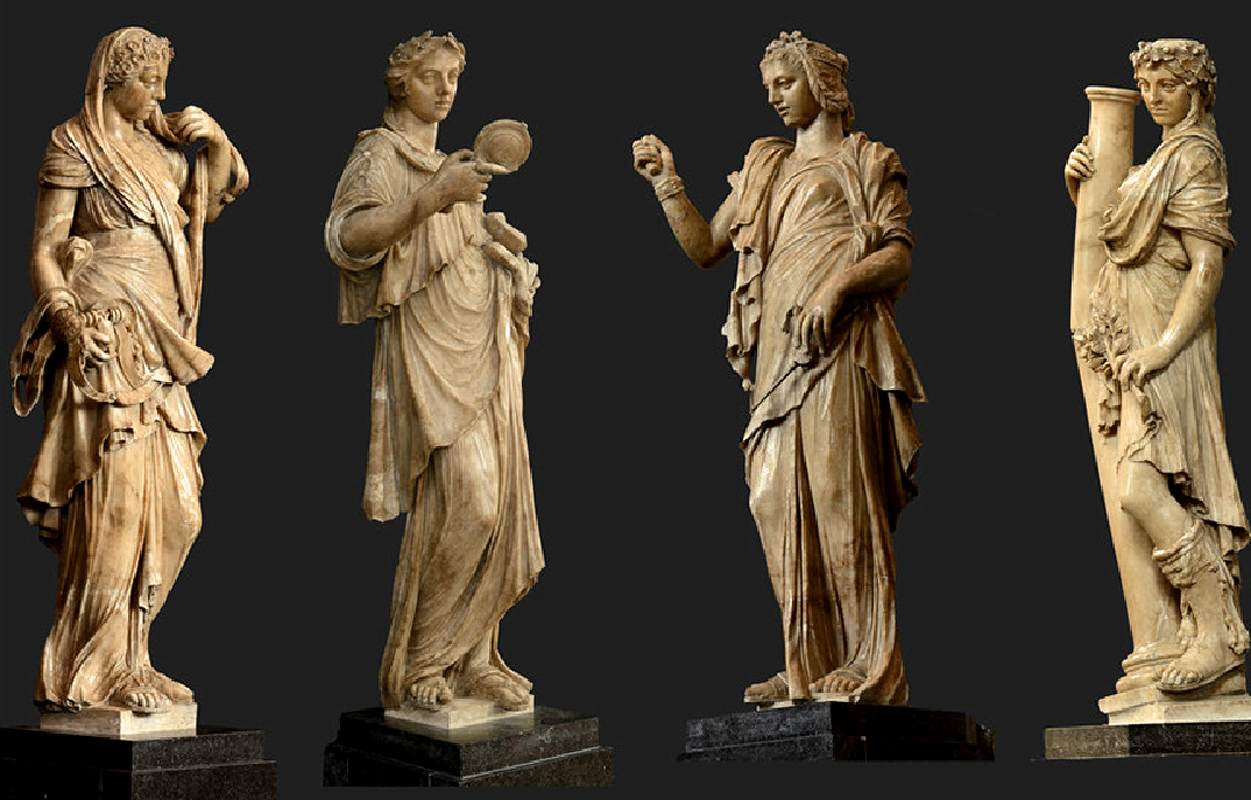
In The Republic, Plato lists four universal, overarching, and essential virtues that every living being should possess to be morally excellent: prudence, temperance, fortitude, and justice. Plato associated these with the social classes of the ideal city and with the faculties of humanity. The point of these virtues is that each enables one to perform well in a particular sphere of life, and the virtues together enable one to live a good life as a whole. The virtues are inseparable - if you have one you have them all, and complete virtue is the key to happiness.
Practical wisdom or prudence (phrónēsis) is the perspicacity necessary to distinguish the beneficial from the detrimental, to understand the attainment of happiness, and to discern the right course of action in every situation. Moderation or temperance (sôphrosunê) is the capacity to temper the indulgence of desires and sensory pleasures within the bounds of what is customary and aligned with experiences already familiar to the soul, maintaining a state of natural self-reliance and exercising proper discipline as and when required. Courage (andreia) can be defined as the ability and self-discipline to conquer fear within oneself when action is necessary and maintaining unwavering fortitude in the face of difficult challenges. Justice (dikaiosunê) is the harmonious alignment of one’s inner self and the comprehensive integrity of the soul. It involves fostering sound judgement and discipline within each facet of our being, refraining from undue harshness, fostering a universal perception of fairness, and upholding principles of social cohesion, thus enabling us to live with others and extend them the same regard.
For Aristotle, virtues are context appropriate means (the golden mean) between an excess and a deficit with respect to some action or emotion; fear is an activity or emotion whose mean is courage, the middle ground between cowardice (deficit) and rashness (excess). Aristotle’s Rhetoric describes forms of virtue as: justice, courage, temperance, magnificence, magnanimity, liberality, gentleness, prudence, and wisdom:
”Wisdom is goodness of the rational part that is productive of the things contributing to happiness. Gentleness is goodness of the passionate part that makes people difficult to move to anger. Courage is goodness of the passionate part that makes them undismayed by fear of death. Sobriety of mind is goodness of the appetitive part that makes them not desirous of the base pleasures of sensual enjoyment. Self-control is goodness of the appetitive part that enables men by means of reason to restrain their appetite when it is set on base pleasures. Righteousness is goodness of the spirit shown in distributing what is according to desert. Liberality is goodness of spirit shown in spending rightly on fine objects. Great-spiritedness is goodness of spirit that enables men to bear good fortune and bad, honor and dishonor.”
Similarly, the ancient Romans primary virtues were FRUGALITAS (frugality), PIETAS (piety), FIRMITAS (fortitude), and GRAVITAS (profound). Like Plato, the Roman philosopher and statesman Cicero in his De Inventione defined virtue as having four parts - wisdom (prudentiam), justice, courage, temperance - as a habit of mind (animi) in harmony with reason and the order of nature. Seneca writes in Consolatio ad Helviam Matrem about justice, self-control, practical wisdom, and devotion instead of courage. Marcus Aurelius discusses these in his Meditations and views them as the “goods” that a person should identify in one’s own mind, as opposed to “wealth or things which conduce to luxury or prestige”.
Early Christian Theologian Ambrose (of Milan) used the expression “cardinal virtues” for temperance, justice, prudence, and fortitude, and Augustine of Hippo described them as:
”temperance is love giving itself entirely to that which is loved; fortitude is love readily bearing all things for the sake of the loved object; justice is love serving only the loved object, and therefore ruling rightly; prudence is love distinguishing with sagacity between what hinders it and what helps it.”
For Augustine, these four virtues are defined as: temperance is love giving itself entirely to that which is loved; fortitude to love readily bearing all things for the sake of the loved object; justice is love serving only the loved object and therefore ruling rightly; prudence is love distinguishing with sagacity between what hinders it and what helps it. (De moribus eccl., Chap xv)
Thomas Aquinas succinctly described the four cardinal virtues as:
Prudence: Good that exists by the act of reason.
Justice: Good put into order in operations.
Fortitude: Good imposed into order by strengthening against fear.
Temperance: Good imposed into order by curbing the passions.
The four “cardinal” virtues are not the same as the three “theological” virtues: Faith, Hope, and Charity (1 Corinthians 13), but a group of seven virtues is sometimes listed by adding these to the four cardinal virtues.
Intellectual virtues imbue these principles with gratitude, curiosity, and a spirit of wonder and admiration for the cosmos. Studium - a thirst to know and a commitment to understanding how the world works - includes a willingness and desire to be taught by those who know more than we do. The learner that diligently stays on tasks and resists distraction is inspired to know the true, good, and beautiful, and attentively seeks to grasp, know, and enjoy them. To face difficulties that may appear daunting and to overcome them with perseverance requires tenacity and a disciplined disposition, as well as the prudent use of time and energy to do the work carefully to completion. All deep learning must be done by the student who decides to learn for herself and to cooperate with her teachers takes self-responsibility.2 These “virtuous” concepts apply similarly to any endeavor, whether moral, practical, or otherwise, as one who maintains, applies, and perfects these universal and timeless principles is certain to realize their true potential and become his ultimate, integrated, and authentic self.
The Principles of Classical Pedagogy, Dr. Christopher Perrin
ibid